Vocabulary
English
six
seven
ten
evening
meal/rice
meal/rice (hon.)
dinner
coffee
this, the current
this evening
today (this day)
tomorrow
tomorrow evening
‘again, tomorrow
to repeat
masu (formal)
dict (casual)
-te (imperative)
romaji
roku
shichi
juu
ban
han
go-han
ban-go-han
kouhii
kon
kon-ban
kyou
ashita
ashita no ban
mata ashita
kurikaeshi-masu
kurikaesu
kurikaeshite
kana
ろく
しち
じゅう
ばん
はん
ごはん
ばんごはん
コーヒー
こん
こんばん
きょう
あした
あしたの ばん
また あした
くりかえします
くりかえす
くりかえして
kanji
六
七
十
晩
飯
ご飯
晩ご飯
今
今晩
今日
明日
明日の晩
また明日
- 飯 (han), which has become synonymous of ‘meal’, refers specifically to cooked rice.
Sample sentences
Tonight I’m going to eat dinner at 9:00 o’clock.
formal
kon-ban ku-ji ni ban-go-han wo tabe-masu.
こんばん くじに ばんごはんを たべます。
今晩九時に晩ご飯を食べます。
casual
kon-ban ku-ji ni ban-go-han taberu.
こんばん くじに ばんごはん たべる。
今晩九時に晩ご飯食べる。
Comments
The following comments explain some of the grammar in more detail.
Prefixes and suffixes
kon – こん,今
こん means ‘this’ or ‘the current’; it refers to time only. Its kanji, 今, is pronounced ‘ima’ when it is alone, and (commonly) ‘kon’ when it’s part of a word:
English
now (this time)
this evening
‘evening?
today (this day)
‘today?
this week
this month
this year
romaji
ima
kon-ban
kon-ban-wa
kyou
kon-nichi-wa
kon-shuu
kon-getsu
ko-toshi
kana
いま
こんばん
こんばんは
きょう
こんにちは
こんじゅう
こんげつ
ことし
kanji
今
今晩
今晩は
今日
今日は
今週
今月
今年
- ‘today’ (今日) looses the ‘kon’ prefix, and instead of being ‘kon-nichi’ (今日) is ‘kyou’.
- ‘kon-ban-wa’ literally is ‘How about this evening?’ but it’s treated just as the ‘good evening’ greeting
Nouns
Digits
This lesson finishes introducing the digits:
English
one
two
three
four
five
six
seven
eight
nine
ten
romaji
ichi
ni
san
shi
go
roku
shichi
hachi
ku
juu
kana
いち
に
さん
し
ご
ろく
しち
はち
く
じゅう
kanji
一
二
三
四
五
六
七
八
九
十
These names have a Chinese origin but, unfortunately, the sound of some of them has an ‘unpleasant’ meaning in Japanese, so the Japanese concocted alternative names for such numbers:
English
four
seven
nine
romaji
shi
shi-chi
ku
Japanese meaning
death
death-blood
pain, suffering
alternate name
yon
nana
kyuu
In general, it’s a matter of personal preference whether we say 4 as ‘shi’ or ‘yon’; same thing with 7, and 9. In some cases, it isn’t, though, and we have to use either one form or the other. For example, “4:00 o’clock” is always ‘yo-ji’, never ‘shi-ji’; and ‘7:00 o’clock’ is always ‘shichi-ji’, never ‘nana-ji’.
The names of some of the four biggest Japanese islands are based on the number of provinces they used to have:
English
Honshu
Hokkaido
Kyushu
Shikoku
romaji
hon-shuu
hok-kai-dou
kyuu-shuu
shi-koku
kanji
本州
九州
四国
meaning
Main province
Nine provinces
Four countries
where ‘shuu’ (州) means ‘province’. Kyushu used to be called ‘kyuu-koku’ (九国, ‘Nine Countries’).
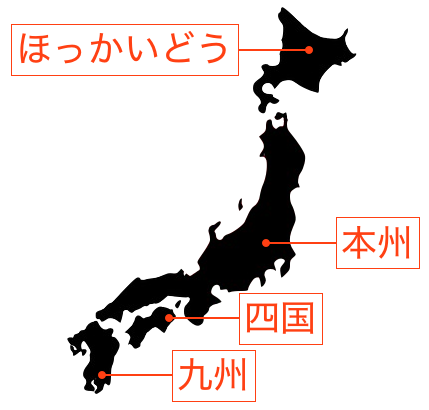
The largest four islands of Japan: Honshu, Hokkaido, Kyushu, and Shikoku.
Ashita – 明日
Ashita means ‘tomorrow’. Let’s compare its kanjis together with those for ‘today’, i.e., 今日.
English
now, the current
bright, the coming
Sun, day
kanji
今
明
日
kun-yomi
ima
a-karu
hi
on-yomi
kon
myou
nichi
Hence, we would expect ‘today’ to be ‘kon-nichi’, instead of ‘kyou’; still, ‘kon-nichi’ is the base of ‘kon-nichi-wa’, which means ‘(how about) this day?’, or ‘hello’. Likewise, we would expect ‘tomorrow’ to be ‘myou-nichi’ and, indeed, ‘myou-nichi’ is a very formal way to say ‘tomorrow’. In addition, another formal way to say ‘tomorrow’, common in weather forecasting, is ‘asu’. All ‘ashita’, ‘asu’, and ‘myou-nichi’ mean ‘tomorrow’ and are written with the same kanjis, i.e., 明日:
politeness level
very formal
formal
casual
romaji
myou-nichi
asu
ashita
kana
みょうにち
あす
あした
kanji
明日
明日
明日